TLDR: If you’re thinking about getting an EV, and very long road trips are super important, and you are not detail-oriented and comfortable with apps and software, just get a Tesla. (Or maybe I should say really do your homework before buying a non-Tesla.)
Details (Skip to Our Experience if this bores you.)
EV trips need to be planned, otherwise you could run out of battery.
Trip planning requires software. Tesla’s have excellent built-in trip planning software. (Not to mention a great charging network.)
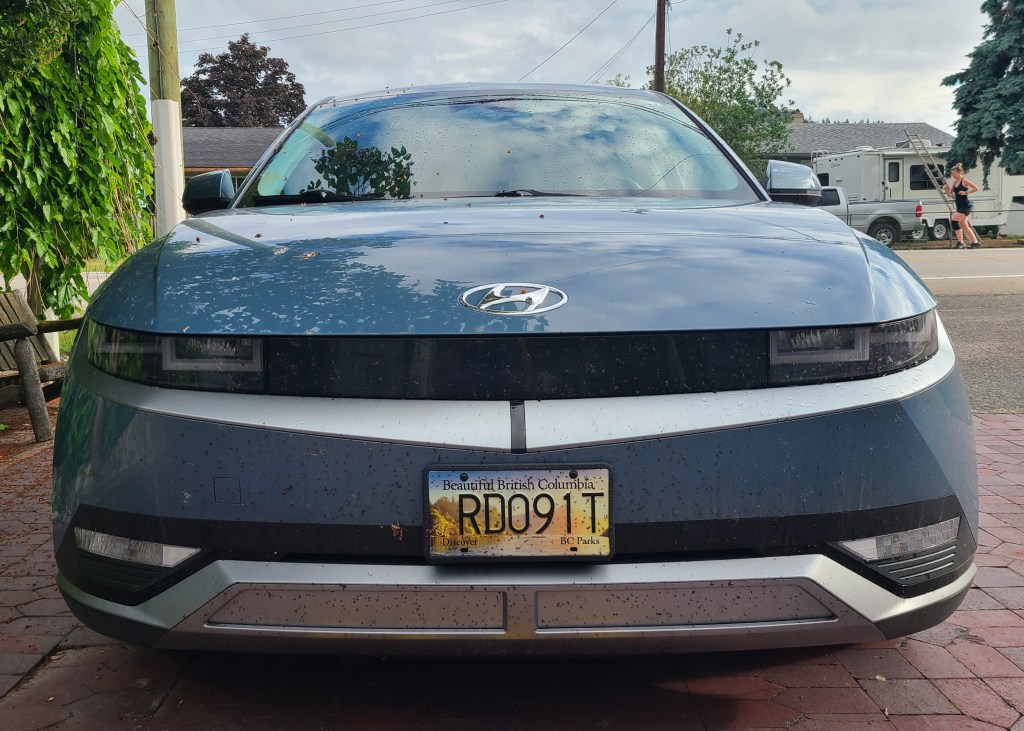
We have a Hyundai Ionic 5. Hyundai’s built-in trip planning software is terrible.
Without good built-in software, you need to depend on phone apps. Fortunately, our car runs Carplay and Android Auto very well.
The apps we use are ABRP – A Better Route Planner – and Plugshare.
ABRP will optimize a route (Beginning, waypoints, charging stops, destination) based on info you put in the app – type of car, weather, how fast you drive, what state of charge you wish to stay above, etc. It chooses charging stops based on speed. It assumes that chargers are working properly, at full power.
Plugshare provides charger details – type, power, and whether they are broken or not. It also lets users post their experience with them
Our battery is typical in size – 77kW of which 72 kW is useable. Our normal efficiency averages 17.2 kW per 100 km, giving a normal range of (72/17.2*100) = 419 km.
Speeds for direct current (DC) fast chargers range from 50 kW to 350 kW per hour.
There are at least 8 companies that provide charging, and each one uses a different app.
Home and free chargers – Type 2 chargers – work on 220 volts AC, like a clothes dryer. They take several hours to charge so are only practical overnight
EV’s also come with Type 1 chargers that you can plug into a regular 110 volt outlet, but they take days to charge so they’re emergency only.
Pricing for DC fast chargers is per minute (not per kW). Faster chargers cost more per minute – 200-350 kW are around $0.50 per minute, 50 kW are typically $0.23 per minute.
Our car can charge fast – up to 240 kW
Our Experience
The charging apps are quirky and often non-intuitive. They take a while to master. (With Tesla you just plug in.)
Wind resistance is a big deal. We left Calgary thinking the flat prairie would result in higher than normal efficiency. After driving for a while at around 125 km/h I checked our progress and was surprised to see we would reach out next charge with -3% battery. What we hadn’t realized was that we were driving into a significant headwind and our efficiency had dropped to 23.8 kW/100 km. Negative battery charge is bad, so we had to backtrack 13 km to the closest charger. Lesson learned.
I’m writing this in Kingston after a bit of slower driving, including an unfortunate incident that I’ll describe below, and our efficiency for the trip is around 18.8 kW/100 km for an average range of (72/18.8*100) = 383 km.
Chargers are too often broken or slow charging. On our very first charge, a short top-up in Hope, the Electrify Canada charger we plugged into would not work. Fortunately, another one of the four was available and it worked fine.
For the portion of the trip past Thunder Bay, we had to change routes because of a broken charger in Wawa. We only learned about it from checking Plugshare.
Instead of driving along Lake Superior we were forced to the northern route through Kapuskasing. We were sad to change, but the scenery on the northern route was still really nice.
The broken charger in Wawa was a Petro Canada charger that had been down over 3 weeks. Unfortunately, this route is a charging desert and this particular charger is critical – the only alternative other than super slow type 2 chargers. Some westbound drivers who were in a hurry, and who had probably never heard of Plugshare, were having to get their cars towed up to 200k to Marathon to get charged. Ouch.
The other problem with Petro Can is you never know what speed the older 200kW units will charge at. It’s painful paying $0.50/minute and getting 41 kW when you could have chosen a 50kW charger that delivers as promised for $0.23/minute. But the possibility that it will deliver 100+ kW means you try anyway. We call it charger roulette.
You’d think Petro Can would be more focused on delivering a great charging experience. Until, of course, you realize that it is owned by Suncor, one of the biggest players in the Alberta tar sands. As the kids say, “just sayin”.
That said, our best experience was at the Medicine Hat Petro Can on a brand new 350 kW charger where we hit 234kW (close to maximum for our car) and charged 74% (53kW) in 18 minutes for around $9 including tax. On this trip that would get us (53/18.4*100) = 288 km. Compared to our old Prius, which probably averaged around 6 l/100 km on the highway, it’s the equivalent of (288*6/100) = 17.3 l of gas. At $1.62/l that’s $28 compared to $9 that we paid. Pretty good savings.
We ran into a problem on the stretch between Timmins and Pakenham. The Jule charger in Mattawa kept stopping, and their engineer couldn’t fix it remotely. So, we drove the speed limit to Petawawa where one of the two chargers was down. Unfortunately we chose the wrong one, and before we had a chance to move over, we got scooped by another guy.
So, we took a chance and pushed forward to Renfrew, again driving the speed limit, and this time with the A/C off. (I hate being that guy with a string of cars behind him.) In Rankin, only one of two chargers were operating, and it was occupied. But the fellow was a local and was kind enough to let us use it. Super nice guy driving a nice blue Mustang Mach E.
Conclusion
Travelling with a non-Tesla EV can be a challenge. But we’re pretty good at it now and for lots of reasons we wouldn’t want to do it any other way.


 Two Sore Backs
Leave a comment